CommonWatch Complaints
Complaints and anonymous reporting, from report key to decision letter.
Public complaints, whistleblower and anonymous reports for police services, transit agencies and public bodies: clocks from your regime, a conflict check before assignment, evidence with its chain of custody and a decision letter drafted from the findings.
Book a demoWho it is forProfessional standards units, ethics offices and investigators.
+
Professional standards units, ethics offices and investigators.
CommonWatch Complaints is for intake officers, investigators, decision makers and professional standards leads who handle public complaints about police conduct, and ethics, safety and fraud reports at transit agencies and public bodies.
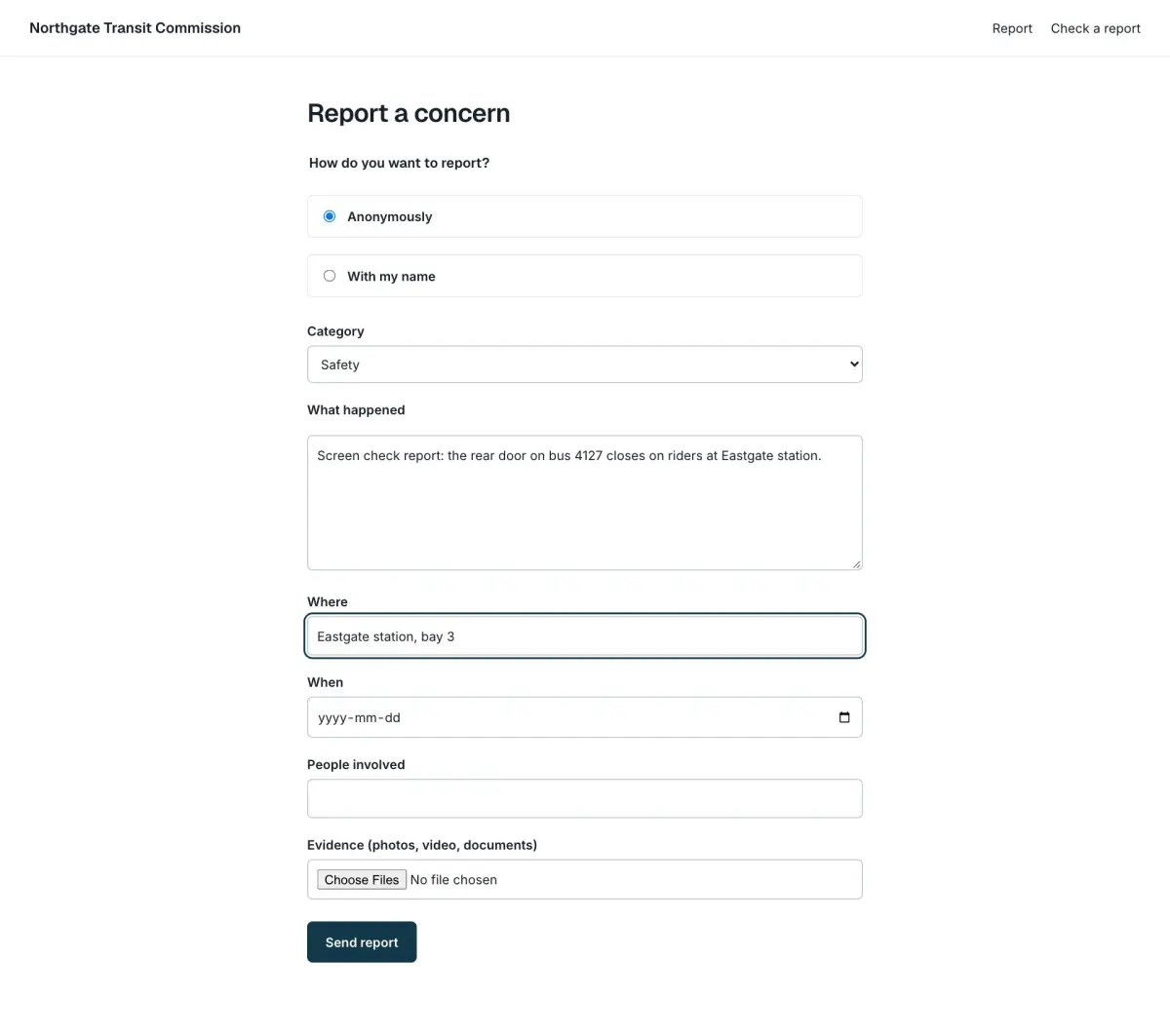
ReportsAnonymous or named, with a report key.
+
Anonymous or named, with a report key.
- Anonymous or with a name. Anonymous reports keep no name, email, phone or contact.
- Report key. Every report gets a key. Only a salted SHA-256 hash is stored, with the last four characters as a hint, and the key can't change.
- Evidence upload. Photos, video and documents, each fingerprinted with SHA-256 at intake.
- Reporter mailbox. Staff write to the reporter on the report. Every message is fingerprinted and can't be changed.
ClocksStatutory and policy clocks set per regime.
+
Statutory and policy clocks set per regime.
Each regime sets its clocks for acknowledgement, screening, investigation, progress reports and decision, in business or calendar days. Regimes ship for Ontario public complaints (CSPA 2019, LECA), Manitoba (LERA), Saskatchewan (PCC) and a transit ethics and safety policy.
Extensions are capped and need a reason from a lead or decision maker. Suspensions, such as a criminal review running, need a reason and add their days. The case board shows clocks on time, at risk and breached.
InvestigationsConflict checks, an append-only log and chain of custody.
+
Conflict checks, an append-only log and chain of custody.
- Screening. Screening a report out needs reasons.
- Conflict check. Assignment is refused when the investigator is a party, works in the subject's unit or has declared a conflict, unless a lead overrides with a reason. Every check is recorded.
- Investigation log. Steps, interviews and decisions in one append-only, hash-chained timeline. A decision needs its rationale.
- Chain of custody. Each evidence item gets a reference and a Received entry at intake. Its fingerprint can't change. Custody entries are append-only and hash-chained, transfers move the custodian, and only a lead can record destruction.
DecisionsDecision letters drafted from every finding.
+
Decision letters drafted from every finding.
Each allegation carries a finding and its reasons. Draft now writes the decision letter from the regime's template with every allegation, finding, reason and outcome, and the review right with its deadline. Approval by the decision maker fingerprints the letter and posts it to the reporter's mailbox.
A case closes only when every allegation has a finding and the letter is approved. Closing sets the retention date from the regime. Appeals link the approved decision and record whether they arrived within the review window.
Procurement factsRoles, hosting and sign-in.
+
Roles, hosting and sign-in.
- Roles. Intake Officer, Investigator (own cases only), Decision Maker, Professional Standards Lead and Read-only.
- Canadian data residency. Installed in your own Microsoft tenant, or hosted by Two Rivers Digital, on Microsoft Dataverse in Canadian regions.
- Single sign-on. Staff sign in with Microsoft Entra ID under your multifactor and conditional access policies.
- Modular. Complaints installs on its own or next to CommonWatch FOI, Recruit and Continuity.
Common questions
What is CommonWatch Complaints?
CommonWatch Complaints is complaints management and anonymous reporting software for police services, transit agencies and public bodies, built by Two Rivers Digital on Microsoft Dataverse. It covers report intake with a report key, statutory clocks, conflict checks, investigations with chain of custody and decision letters.
Which complaint regimes does it ship with?
Ontario public complaints (CSPA 2019, LECA), Manitoba (LERA), Saskatchewan (PCC) and a transit ethics and safety policy. Each regime sets its own clocks in business or calendar days.
How do anonymous reporters follow their report?
Every report gets a report key. Only a salted SHA-256 hash of the key is stored. The reporter uses it to read and answer staff messages in the reporter mailbox, and anonymous reports keep no name, email or phone.
How is evidence kept?
Each item gets a reference and a SHA-256 fingerprint at intake. Custody entries are append-only and hash-chained, transfers move the custodian, and only a lead can record destruction.
Published · Updated